
Interview With An Antifa Member

The Weekly Spook was lucky enough to get to do an interview with an Antifa member — a mythical creature that does not, in fact, exist. But still, we were able to work it out, much like many other news outlets have in the past.
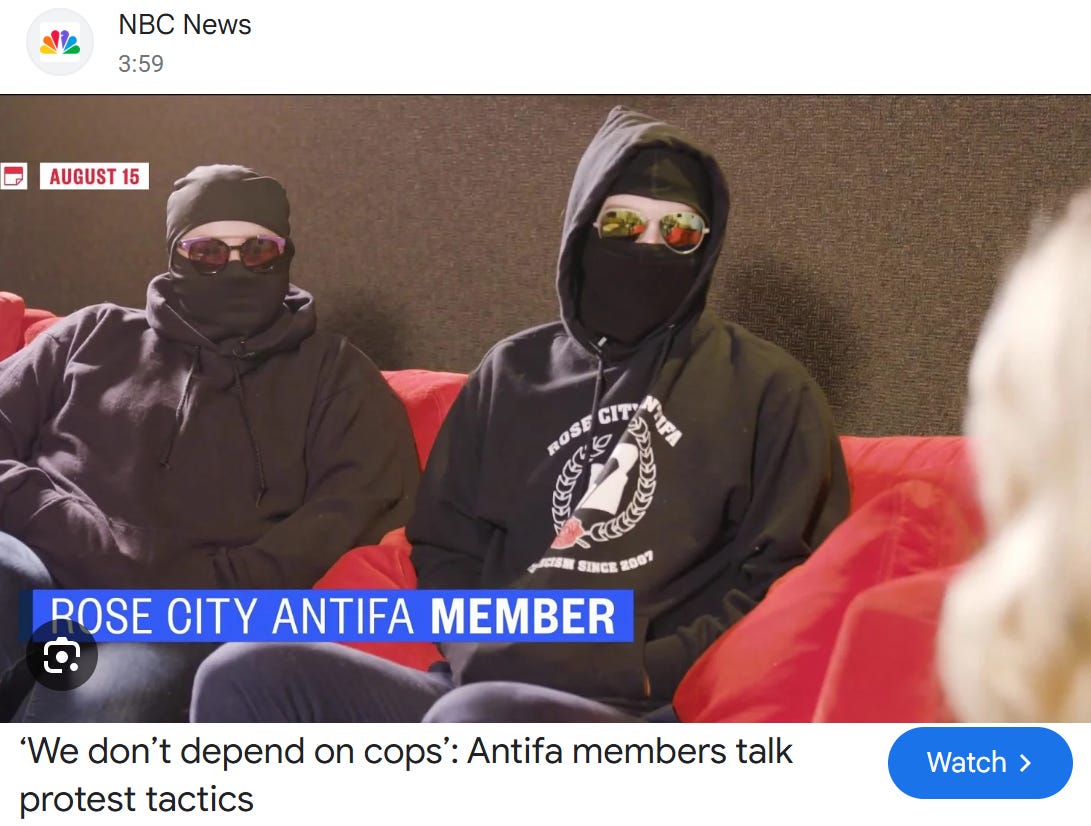
Given that mainstream media outlets and pundits like Jimmy Kimmel continue to emphasize that Antifa is “entirely imaginary” and “nothing,” and that “nobody” is a member, we decided to contact Nobody for an interview to help us understand how “Antifa” could be both shortlisted for the 2017 Word of the Year and also something completely nonexistent, or a “mythology” that the far right is “declaring into existence.”
Sitting across from us in an empty chair, Nobody explained in response to our request for a definition, “Antifa is just a hashtag.”
So it’s a word used on social media sites to identify digital content related to…?
“Related to Antifa.”
Which is nothing?
“Well, on the one hand it’s nothing, but on the other hand, Antifa is a movement rooted in resisting fascism — we are all united in our fight against fascism,” Nobody remarked. “But it’s also entirely imaginary and literally doesn’t exist.”
Does it not exist in the same way that you and I are merely the universe experiencing itself, but we also have bodies and are having this conversation? we asked.
“Yes, exactly,” Nobody responded. “#Antifa.”
So who is “we”?
“Nobody,” Nobody said. “Just like we, the ether.”
So it doesn’t have members?
“It’s hard to define,” said Nobody. “Kind of like a ‘woman’ — no one really knows what it is. I think Antifa is in all of us if we choose to identify with that part of ourselves. So whoever does that is a member — which is no one,” Nobody clarified. “But also, members are those who communicate among themselves to organize and take action, like punching people in the face and blowing up cars and stuff.”
Just before turning eerily transparent and disappearing entirely into thin air, Nobody added, “Don’t get it twisted, Antifa and its members are a powerful force against tyranny, but definitely not something that’s real in the strict sense of the word, like me.” Poof!
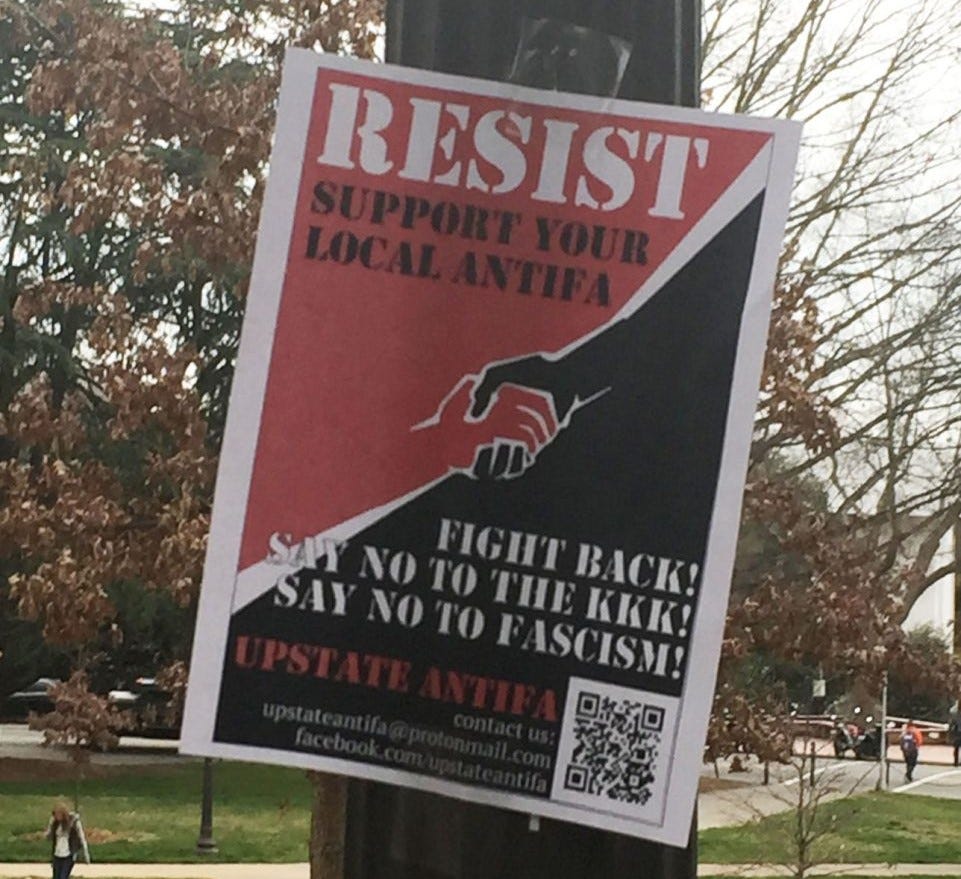
While Nobody provided us with valuable insight into the fictitious Antifa, we wanted to dig a little deeper. So we turned to Mark Bray, Assistant Professor of History at Rutgers University. Bray, who is an expert on nothing (Antifa) and author of Antifa: The Anti-Fascist Handbook — a book he just thought up and that doesn’t actually exist — explains in his fake book that the movement, if it existed, would have stemmed from Anti-Racist Action (ARA), a decentralized network of militant far-left political cells in the United States and Canada beginning in the 1980s.
In his make-believe tome, Bray emphasizes that “it’s important to understand that Antifa politics, and Antifa’s methods, are designed to stop white supremacists, fascists, and neo-Nazis as easily as possible.” But the question remains: how can nothing have methods to stop something? And how much nothing does it take to become something?
Bray additionally explains in his #book that it’s “impossible to ascertain the exact number of people who belong to Antifa groups… the groups are loosely organized, and they aren’t large enough to cause everything Trump blames them for.” This may be true, but we were left wondering: how can nothing even be a group? And how does one quantify nothing numerically?
In mathematics, we suppose it’s with the number zero, where n + 0 = n. Nothing plus nothing equals nothing.
But mathematics can’t explain the simultaneous existence of nothing and something. So, we looked to philosophy.
In some traditions (e.g., Buddhist śūnyatā or the concept of the void), “nothing” isn’t negative; it’s potential — the space from which all things emerge. Is Antifa the space from which all things emerge? Perhaps this non-movement is far more profound than we thought.
Yet another possible explanation lies in the world of physics and the late, great Erwin Schrödinger, whose famous thought experiment “Schrödinger’s Cat” illustrates the paradoxical concept of something being both alive and dead until observed — something and nothing at once.
Bearing his theory in mind, “Schrödinger’s Antifa” would explain how Antifa could simultaneously exist and not exist, depending on who’s talking about it and what political point they want to make. Antifa is an organization when leftists need a hero, but a concept when they need deniability. In sum, Schrödinger’s Antifa is so organized it can coordinate rebellion to resist fascist governments, but so decentralized it doesn’t technically exist.
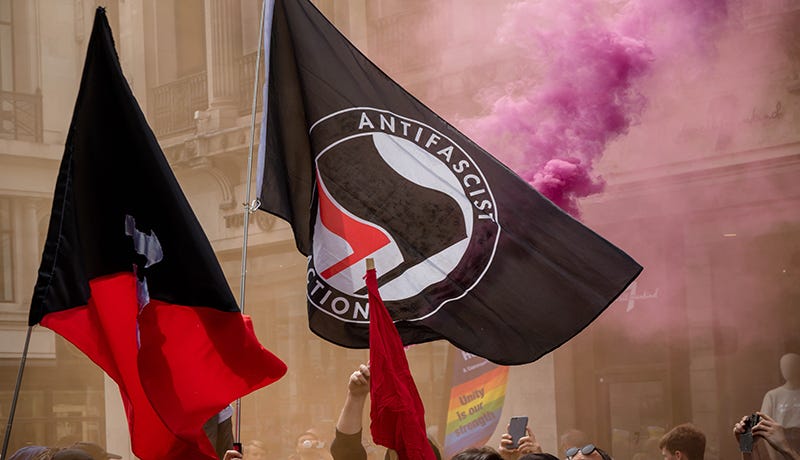
Despite the fact that Antifa doesn’t exist, it does have compelling branding, namely, its logo of two flags representing anarchism and communism, derived from the German Antifa movement (which also doesn’t exist, but in German). The infamous “Antifa” name likewise originates from the German word antifaschistisch, which raises another compelling angle to the debate.
According to Nobody, who flickered back into the room, it’s precisely this name that inherently justifies Antifa’s innate goodness.
“Even if Antifa existed, it would stand for ‘anti-fascist,’ which is an objectively good thing. Fascists are bad. We’re anti-that. So you see, no one can really be against us unless they’re a fascist themselves. It’s literally in the name.”
So Antifa is also in support of the pro-life movement, then? we asked.
“Evil is a point of view,” Nobody responded. “We are immortal.”
With that, Nobody left the chat, and we were left to wonder if the interview was real or simply a collective dream from which we had just awoken. Spooky stuff.